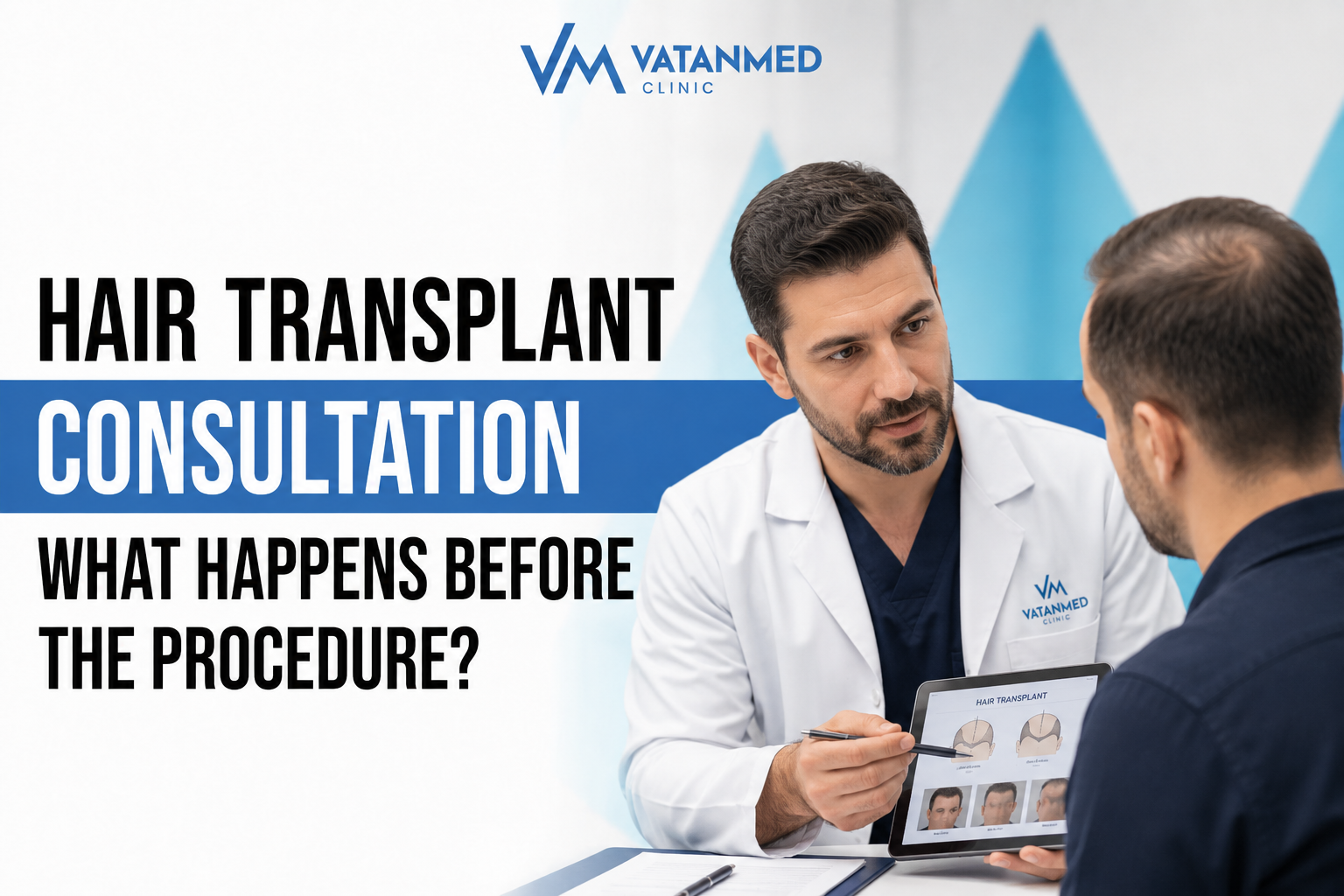
A hair transplant consultation is one of the most important steps before treatment. Many patients focus on the day of the procedure, the number of grafts, or the final result, but the quality of the consultation often determines how realistic, safe, and suitable the treatment plan will be.
A hair transplant is not a simple cosmetic decision. It is a medical and aesthetic procedure that requires careful planning. Before any grafts are extracted or implanted, the clinic needs to understand the patient’s hair loss pattern, donor area, expectations, general health, scalp condition, and long-term goals.
At VatanMed, patients can learn more about hair transplant services here: https://vatanmed.com/hair-transplant/. The consultation process helps decide whether a patient is suitable for treatment and which technique may be appropriate, such as Sapphire FUE or DHI hair transplant.
This guide explains what normally happens during a hair transplant consultation, what information patients should prepare, what questions they should ask, and why proper planning is essential before the procedure.
Why Is a Hair Transplant Consultation Important?
A hair transplant consultation is important because every patient’s hair loss is different. Two people may both have a receding hairline, but their donor area, age, hair quality, scalp condition, expectations, and future hair loss risk may be completely different.
A consultation allows the clinic to assess the individual case before recommending treatment. It also gives the patient an opportunity to understand what can realistically be achieved.
The American Academy of Dermatology explains that effective hair loss treatment begins with finding the cause of hair loss. You can read more from AAD here: https://www.aad.org/public/diseases/hair-loss/treatment/diagnosis-treat. This is important because not every type of hair loss should be treated with a transplant immediately. Some patients may need diagnosis, medical treatment, or further evaluation before surgery is considered.
A professional consultation should help answer three important questions:
Is the patient suitable for a hair transplant?
What result can realistically be achieved?
How should the treatment be planned for long-term natural appearance?
What Information Should You Prepare Before the Consultation?
Before a hair transplant consultation, it is helpful to prepare accurate information. This makes the assessment more useful and helps the clinic understand your situation properly.
You should be ready to discuss:
When your hair loss started
Whether the hair loss is stable or still progressing
Family history of hair loss
Previous hair loss treatments
Any medications you currently take
Medical conditions or allergies
Previous surgeries or scalp procedures
Your expectations from the treatment
Your preferred timeline for the procedure
Any concerns about recovery or aftercare
If you are having an online consultation, clear photos are very important. These may include front view, side views, crown view, donor area view, and photos under natural lighting. Blurry or dark images can make assessment less accurate.
Patients who want to contact the VatanMed team can use the Contact Us page here: https://vatanmed.com/contact-us/.
What Happens During the First Assessment?
During the first assessment, the clinic usually reviews the visible hair loss pattern and discusses the patient’s goals. The aim is not only to see where hair has been lost, but also to understand why the hair loss is happening and whether it is suitable for transplantation.
The assessment may include:
Reviewing the hairline
Checking the crown area
Looking at thinning zones
Assessing the donor area
Discussing the patient’s age and hair loss history
Reviewing previous treatments
Understanding the desired result
Explaining realistic limitations
This stage is especially important for patients who want a very low hairline or very high density. A good treatment plan must respect the available donor area and the long-term appearance of the patient.
How Is the Donor Area Checked?
The donor area is usually located at the back and sides of the scalp. It provides the grafts used during the hair transplant. Because donor hair is limited, the donor area must be assessed carefully before planning the procedure.
The clinic may check:
Donor density
Hair thickness
Hair quality
Scalp condition
Previous extraction marks
Whether the donor area is stable
How many grafts may be safely available
A strong donor area can provide more flexibility in planning. A weaker donor area may require a more conservative approach. This does not always mean treatment is impossible, but it means the plan must be realistic.
The NHS explains that a hair transplant involves moving hair to an area that is thin or bald and advises patients to check the experience and qualifications of the practitioner. You can read the NHS hair transplant guide here: https://www.nhs.uk/tests-and-treatments/cosmetic-procedures/cosmetic-surgery/hair-transplant/.
Why Graft Numbers Are Discussed During Consultation
Many patients ask, “How many grafts do I need?” This is a fair question, but the answer depends on several factors.
Graft numbers are influenced by:
Size of the thinning area
Desired density
Hair thickness
Hairline design
Donor area strength
Previous hair loss
Future hair loss risk
Technique used
Patient expectations
More grafts do not automatically mean a better result. The right number of grafts is the number that can be used safely and naturally based on the patient’s donor area and treatment goals.
A responsible clinic should not promise an excessive graft number if the donor area cannot safely support it. Overharvesting can make the donor area look thin or uneven and may reduce options for future treatment.
How Is the Hairline Planned?
Hairline planning is one of the most important parts of the consultation. A natural hairline should match the patient’s age, face shape, hair type, donor area, and future hair loss risk.
A hairline that is too low or too straight can look unnatural, especially as the patient gets older. In many cases, a slightly more conservative and mature hairline gives a more natural long-term appearance.
Hairline planning usually considers:
Facial proportions
Forehead shape
Age
Hair type
Density goals
Donor supply
Future hair loss
Natural direction of hair growth
The aim should be a result that looks natural in real life, not only in photos immediately after surgery.
Which Technique Is Discussed During Consultation?
During the consultation, the clinic may explain whether Sapphire FUE, DHI, or another approach may be suitable. The best technique depends on the patient’s hair loss pattern, donor area, recipient area, hair type, and treatment goals.
Sapphire FUE and DHI are both modern approaches used in hair transplantation, but technique alone does not guarantee a successful result. The quality of planning, graft handling, medical supervision, implantation direction, aftercare, and patient suitability all matter.
Patients should avoid choosing a clinic based only on technique names. A professional consultation should explain why a certain technique is recommended for the individual patient.
Patients can explore VatanMed clinic locations through the Branches page here: https://vatanmed.com/branches/.
Medical History and Safety Questions
A hair transplant consultation should include medical questions. This is not just paperwork. Medical history helps the clinic assess safety, healing, and suitability.
Patients may be asked about:
Blood pressure
Diabetes
Heart conditions
Bleeding disorders
Autoimmune conditions
Skin conditions
Allergies
Current medications
Previous anaesthetic reactions
Smoking or alcohol habits
Previous operations
This information helps the clinic make safer decisions. Some patients may need additional medical clearance before treatment. Others may need to delay the procedure or take specific precautions.
The International Society of Hair Restoration Surgery provides patient information and promotes standards in hair restoration surgery. You can review ISHRS information here: https://ishrs.org/.
What Should Be Explained Before the Procedure?
Before a patient agrees to treatment, the clinic should explain the procedure clearly. This includes what happens before, during, and after the transplant.
Patients should understand:
How the donor area will be prepared
How grafts will be extracted
How the recipient area will be planned
How long the procedure may take
What type of aftercare is needed
What side effects may occur
How long healing usually takes
When new growth may begin
When final results may be expected
What limitations apply to their case
The American Society of Plastic Surgeons provides patient information about hair transplant recovery here: https://www.plasticsurgery.org/cosmetic-procedures/hair-transplantation-and-restoration/recovery. Recovery information is important because the treatment journey continues after the procedure day.
What Questions Should Patients Ask?
A consultation should be a two-way conversation. Patients should not be afraid to ask questions. Clear answers help build confidence and reduce misunderstandings.
Useful questions include:
Am I a suitable candidate for a hair transplant?
What is the likely cause of my hair loss?
Is my donor area strong enough?
How many grafts can be used safely?
Which technique is recommended for me and why?
What result can I realistically expect?
How will my hairline be designed?
What are the possible risks or side effects?
What aftercare will I need to follow?
How long will it take to see growth?
Will I need future treatment if hair loss continues?
Patients can also review VatanMed’s general FAQ page here: https://vatanmed.com/frequently-asked-questions/.
Online Consultation vs In-Person Consultation
Many international patients begin with an online consultation. This can be useful for an initial assessment, especially for patients travelling from another country or city.
An online consultation may include:
Reviewing photos
Discussing hair loss history
Understanding expectations
Giving an initial opinion
Explaining possible treatment options
Advising whether an in-person visit is needed
However, an online consultation has limitations. It cannot always fully replace direct scalp assessment. Lighting, photo quality, hair length, and angles can affect the accuracy of evaluation.
An in-person consultation allows the clinic to examine the scalp and donor area more closely. For many patients, the final treatment plan is confirmed after physical assessment.
Why Expectations Must Be Discussed Honestly
Expectation management is one of the most important parts of a hair transplant consultation. Patients should understand that results vary and that no clinic can promise the exact same outcome for everyone.
The final result can depend on:
Donor hair quality
Graft survival
Hair thickness
Skin healing
Aftercare
Hair loss progression
Technique suitability
Medical factors
A professional clinic should explain both the possibilities and the limitations. This protects the patient from disappointment and supports a more realistic decision.
What Happens After the Consultation?
After the consultation, the clinic may provide a treatment recommendation. This may include the suggested technique, estimated graft number, treatment area, aftercare guidance, and expected timeline.
Some patients may be advised to proceed with treatment. Others may be advised to wait, treat an underlying issue, improve scalp condition, or consider a different approach.
A consultation should never pressure the patient into an immediate decision. A hair transplant has long-term consequences, so patients should feel informed and comfortable before moving forward.
Why Choose a Clinic With Structured Planning?
A clinic with structured planning focuses on the full patient journey, not only the procedure itself. This includes consultation, donor assessment, hairline design, graft planning, procedure quality, aftercare, and follow-up.
VatanMed has experience in hair, beard, moustache, and eyebrow transplantation and serves patients across multiple clinic locations. Patients can learn more about VatanMed through the official website here: https://vatanmed.com/.
For international patients, this structured approach is especially important because communication, planning, travel, and aftercare need to be clear before treatment.
Frequently Asked Questions
What happens during a hair transplant consultation?
During a consultation, the clinic assesses your hair loss pattern, donor area, medical history, expectations, and possible treatment options. The goal is to decide whether you are suitable for a hair transplant and how treatment should be planned.
Can I have a hair transplant consultation online?
Yes, many patients begin with an online consultation. Clear photos and accurate information are important. However, a final plan may still require in-person assessment.
Is a consultation required before a hair transplant?
Yes. A consultation is essential because not every patient is suitable for a hair transplant. The clinic must assess the donor area, hair loss cause, scalp condition, and expectations.
Will I know how many grafts I need during consultation?
The clinic may provide an estimated graft number after assessing your donor area and treatment goals. The final number depends on individual factors.
What should I ask before having a hair transplant?
You should ask about suitability, donor area strength, technique, graft numbers, hairline design, recovery, aftercare, risks, and realistic expectations.
Does a consultation mean I must have the procedure?
No. A consultation is an assessment and information process. It helps you understand your options before making a decision.
Final Thoughts
A hair transplant consultation is the foundation of safe and realistic treatment planning. It helps determine whether the patient is suitable, how strong the donor area is, which technique may be appropriate, and what result can realistically be achieved.
The best hair transplant plans are not rushed. They are based on careful assessment, honest communication, medical awareness, and long-term thinking.
If you are considering a hair transplant, contact VatanMed for a personalised consultation: https://vatanmed.com/contact-us/.