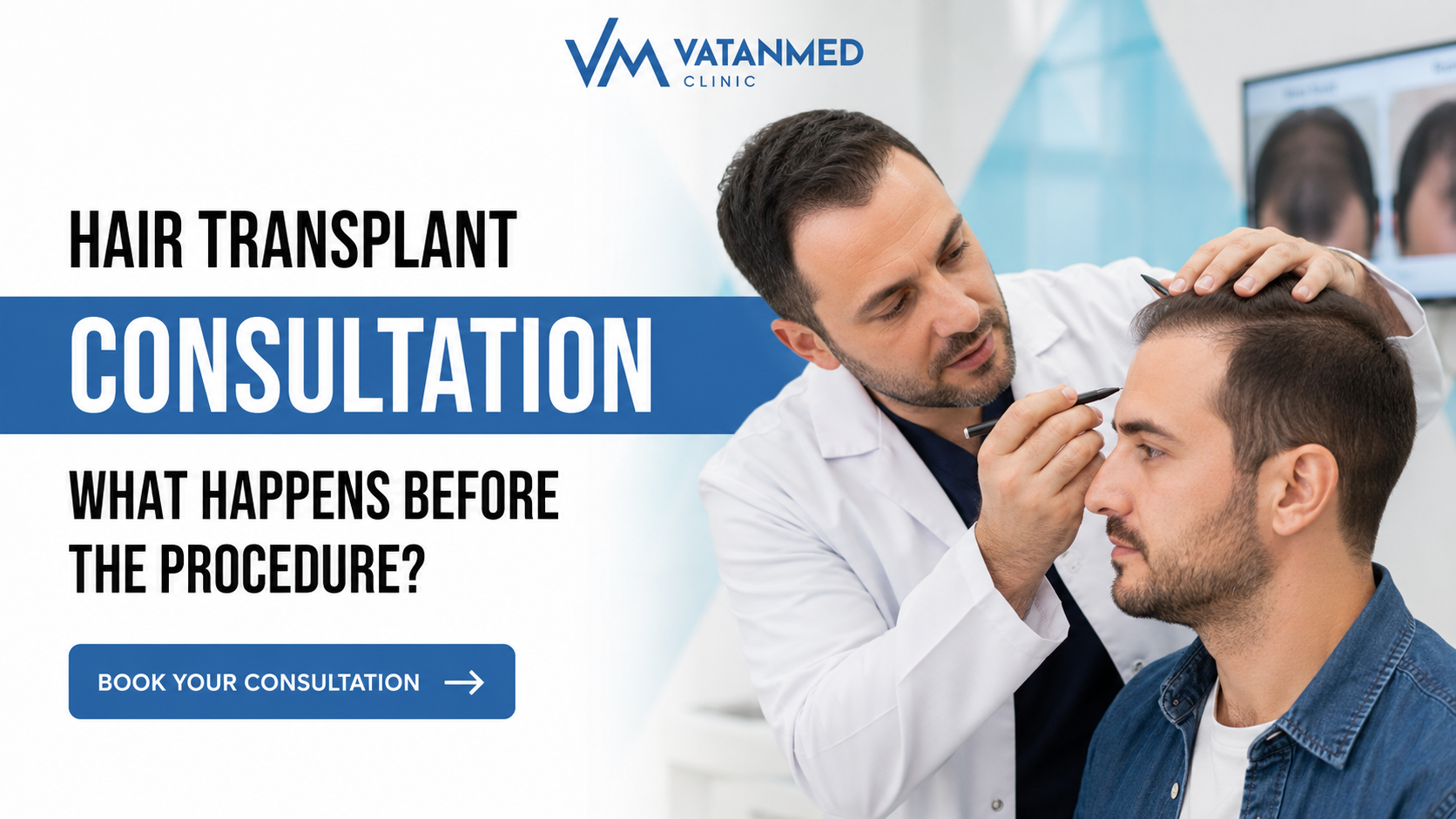
Hair transplant consultation is one of the most important steps before deciding whether hair restoration is right for you. Many patients focus first on price, graft numbers or technique names, but a safe and natural-looking result should begin with proper assessment.
A hair transplant consultation helps the clinic understand your hair loss pattern, donor area strength, expectations, medical background, treatment goals and long-term hair restoration needs. Without this step, it is difficult to know whether surgery is suitable or what result may be realistic.
A consultation should not be treated as a quick sales conversation. It should be a structured review of your case. The clinic should explain what can be achieved, what may be limited, which technique may be suitable and what aftercare will involve.
At VatanMed, patients can learn more about hair transplant services before deciding whether treatment may be suitable. VatanMed provides transplantation services for the head, beard, moustache and eyebrow areas, with international clinic locations and its main branch in Istanbul.
This guide explains what happens during a hair transplant consultation, what photos may be needed, how the donor area is assessed, why realistic planning matters and which questions patients should ask before booking treatment.
Why Hair Transplant Consultation Matters
A hair transplant consultation matters because not every patient with hair loss is automatically suitable for surgery. Hair transplantation can be valuable for selected patients, but the treatment plan must be based on diagnosis, donor area quality, hair loss stage, scalp condition and realistic expectations.
A consultation helps avoid poor planning. For example, a patient may want a very low hairline, but the donor area may not safely support that design. Another patient may want the crown treated first, but the frontal area may need priority. In some cases, surgery may not be the best first option at all.
The NHS hair transplant guide explains that having a hair transplant is a big decision and that patients should find out as much as possible before treatment. It also advises patients to ask about qualifications, experience, complications, procedure type and follow-up.
A consultation should help answer:
- Am I suitable for hair transplantation?
- What type of hair loss do I have?
- Is my donor area strong enough?
- How many grafts may be realistic?
- Which technique may suit my case?
- What result can I reasonably expect?
- What recovery and aftercare will involve?
A professional hair transplant consultation should help the patient make an informed decision, not pressure them into booking quickly.
What Information Should You Share During Consultation?
During a hair transplant consultation, the clinic should ask about your hair loss history and general background. This information helps the team understand whether your hair loss is stable, progressive, temporary or linked to another factor.
Patients should be honest about medical history, medications, previous procedures, scalp problems, allergies, smoking, recent illness, stress, family history and expectations. These details can affect suitability, recovery and treatment planning.
The American Academy of Dermatology hair loss diagnosis guide explains that effective hair loss treatment begins with identifying the cause. This is why the consultation should look beyond only the visible thinning area.
You may be asked about:
- When your hair loss started
- Whether hair loss is gradual or sudden
- Family history of hair loss
- Previous hair transplant procedures
- Current medications or supplements
- Medical conditions or allergies
- Scalp irritation, itching or inflammation
- Hair care habits and styling
- Your main treatment goals
A good hair transplant consultation should connect your goals with what is medically and technically realistic.
Online Hair Transplant Consultation
An online hair transplant consultation can be a useful first step, especially for patients who live far from the clinic or are considering international treatment. Clear photos and accurate information can help the clinic provide an initial assessment.
However, online consultation should not be used as a replacement for proper final assessment. Photos can help with planning, but lighting, angles, hair length and image quality can affect what the clinic can see. The final treatment plan may still need to be confirmed in person.
For online consultation, patients should provide clear images from different angles. These photos should show the front hairline, temples, top of the scalp, crown and donor area at the back and sides of the head.
Useful photos may include:
- Front hairline photo
- Left temple photo
- Right temple photo
- Top of scalp photo
- Crown photo
- Back donor area photo
- Left and right donor side photos
- Photos with hair parted if thinning is diffuse
A reliable online hair transplant consultation should provide guidance, but it should also explain that the final graft number and treatment plan may change after in-person assessment.
Donor Area Assessment
Donor area assessment is one of the most important parts of a hair transplant consultation. The donor area provides the follicles used for transplantation, so it must be assessed carefully before graft numbers are discussed.
The donor area is usually located at the back and sides of the scalp. A strong donor area may allow more flexibility in planning. A weaker donor area may require a more conservative approach or a different treatment strategy.
A responsible clinic should not promise a large graft number without reviewing donor density, hair thickness, scalp condition and safe extraction limits. Donor hair is limited, so it must be protected.
Donor area assessment may include:
- Donor density
- Hair shaft thickness
- Scalp health
- Safe graft availability
- Previous extraction or scarring
- Future hair loss risk
- Risk of overharvesting
Patients can learn more about this topic here: Donor Area Hair Transplant: Key Checks.
Hair Loss Pattern and Future Hair Loss Risk
A hair transplant consultation should assess both the current hair loss and the likely future pattern. This is important because a transplant can restore selected areas, but it does not stop all future native hair loss.
For example, a patient may currently be most concerned about the hairline, but early thinning may also be visible in the crown or mid-scalp. If the plan ignores future hair loss, the result may look uneven later.
The clinic should consider age, family history, hair loss speed, thinning pattern and donor supply. A younger patient with active hair loss may need more conservative planning than an older patient with stable loss.
Hair loss assessment may consider:
- Hairline recession
- Temple thinning
- Mid-scalp density
- Crown thinning
- Diffuse thinning
- Family history
- Speed of progression
- Previous treatment history
A strong hair transplant consultation should look at long-term appearance, not only immediate coverage.
Hairline Planning During Consultation
Hairline planning is another important part of a hair transplant consultation. A natural hairline should suit the patient’s age, face shape, forehead proportions, hair loss pattern and donor area.
Many patients ask for a lower hairline because they want a younger appearance. However, a very low hairline is not always the safest or most natural choice. It can use too many grafts and may not age well if hair loss continues.
The clinic should explain the planned hairline position and why it fits the patient’s case. A good hairline should look natural from the front, sides and close-up.
Hairline planning should consider:
- Age
- Face shape
- Forehead proportions
- Temple recession
- Donor area strength
- Future hair loss risk
- Natural direction of hair growth
- Soft transition at the front
Patients can read more here: Hairline Design Hair Transplant: Why Natural Planning Matters.
Graft Number Planning
Patients often want to know the graft number during a hair transplant consultation. This is understandable, but graft count should be estimated after donor area assessment, hair loss evaluation and hairline planning.
More grafts do not always mean a better result. The right graft number is the number that can improve coverage while protecting the donor area and supporting a natural appearance.
A clinic should explain why it recommends a specific graft range. The explanation should include recipient area size, donor strength, hair thickness, density goals and future hair loss risk.
Graft planning may depend on:
- Size of the thinning area
- Hairline position
- Crown involvement
- Donor area quality
- Hair thickness and texture
- Scalp and hair colour contrast
- Future treatment needs
- Realistic density expectations
Patients can read more here: How Many Grafts Hair Transplant Patients May Need.
Technique Discussion: FUE, Sapphire FUE and DHI
A hair transplant consultation should include a discussion about technique, but technique should be chosen after assessment. FUE, Sapphire FUE and DHI can all be useful in suitable cases, but one method is not automatically best for every patient.
The right technique depends on donor area, recipient area, graft number, hairline design, existing hair, scalp condition and treatment goals. The clinic should explain why a method is recommended and what alternatives may be possible.
The International Society of Hair Restoration Surgery patient education page provides useful patient information about hair restoration and supports informed decision-making before treatment.
Technique choice may depend on:
- Donor area strength
- Recipient area size
- Hairline detail needed
- Existing native hair
- Number of grafts
- Scalp condition
- Recovery expectations
Patients can compare methods here: Sapphire FUE vs DHI: 7 Key Differences.
Medical Safety and Suitability Checks
A proper hair transplant consultation should include medical safety questions. Hair transplantation is usually performed as a cosmetic procedure, but it is still a medical treatment that requires safe planning.
The clinic should ask about health conditions, medication use, allergies, previous surgery, bleeding risk, scalp disease and recovery concerns. Patients should be open and accurate with this information.
The British Association of Aesthetic Plastic Surgeons safety guidance provides patient safety information for people considering cosmetic surgery. This supports the importance of careful preparation and informed decision-making before any aesthetic procedure.
Safety checks may include:
- Medical history review
- Medication review
- Allergy history
- Scalp condition check
- Previous surgery or scarring
- Smoking or lifestyle factors
- Suitability for local anaesthetic
- Recovery and aftercare understanding
A safe hair transplant consultation should explain both the benefits and the possible limitations of treatment.
Recovery and Aftercare Discussion
Recovery should be explained before booking the procedure. A hair transplant consultation should cover washing instructions, sleeping position, scab care, activity restrictions, sun exposure, temporary shedding and expected growth timeline.
Patients should understand that results are not immediate. The early healing stage may involve redness, scabbing, sensitivity and shedding. New growth usually develops gradually over several months.
The American Society of Plastic Surgeons hair transplant recovery guide provides general recovery information after hair transplantation. Patients should always follow the specific instructions provided by their own clinic.
Aftercare discussion should include:
- How to wash the scalp
- How to protect grafts early after surgery
- When to return to work
- When to resume exercise
- How to manage scabs
- What shedding means
- When growth may begin
- What symptoms should be reported
Patients can read more here: Hair Transplant Recovery Timeline: What to Expect Month by Month.
What Results Can Be Expected?
A hair transplant consultation should include honest expectation setting. The clinic should explain what level of improvement may be realistic based on donor area, graft number, hair thickness, hair loss pattern and treatment goals.
Patients should avoid expecting instant full density. Hair transplant results develop gradually. Some shedding may happen first, and density may improve over many months as the transplanted hairs grow and mature.
The NHS hair transplant guide explains that transplanted hair often falls out after a few weeks and later starts to grow back, with full results developing later. This is why patients should avoid judging the final result too early.
Realistic expectations include:
- Results vary between patients
- Final density depends on donor supply
- Temporary shedding may happen
- Growth takes months
- Future native hair loss may continue
- More than one procedure may be needed in some cases
- Aftercare matters during recovery
A responsible hair transplant consultation should be honest about what is possible and what may not be realistic.
Questions to Ask Before Booking
Before booking treatment, patients should use the hair transplant consultation to ask clear questions. A trustworthy clinic should answer these questions openly and professionally.
Patients should not feel rushed. A hair transplant is a long-term decision, and it is reasonable to ask about the treatment plan, donor area, technique, recovery, aftercare and possible risks.
Important questions include:
- Am I suitable for a hair transplant?
- What type of hair loss do I have?
- Is my donor area strong enough?
- How many grafts may be realistic?
- Which technique do you recommend and why?
- How will my hairline be designed?
- What are the risks or limitations?
- What aftercare support is included?
- How will follow-up work?
- What should I do if I have concerns after treatment?
The NHS hair transplant guide also recommends asking about experience, complications, recommended procedure type and follow-up before having surgery.
Warning Signs During Consultation
A hair transplant consultation can also help patients identify warning signs. Not every clinic provides the same level of assessment, transparency or aftercare. Patients should be cautious if the clinic focuses only on price or promises guaranteed results.
Be careful if the clinic gives a graft number before reviewing the donor area, avoids questions about risks, promises unrealistic density or pressures you to book immediately. A responsible clinic should explain both benefits and limitations.
Warning signs may include:
- No proper donor area assessment
- No discussion of hair loss cause
- Guaranteed results for every patient
- Very high graft numbers without explanation
- No clear aftercare plan
- No discussion of risks
- Pressure to book quickly
- Unclear follow-up process
A good hair transplant consultation should make the patient feel informed and confident, not confused or pressured.
Consultation for Beard, Moustache and Eyebrow Transplant
A hair transplant consultation can also apply to beard, moustache and eyebrow transplantation. These procedures require detailed planning because facial hair and eyebrow hair have different angles, directions and density patterns compared with scalp hair.
For beard and moustache restoration, the clinic should assess facial hair pattern, donor hair suitability, graft direction and natural design. For eyebrow restoration, eyebrow shape, angle control and maintenance expectations are especially important.
Patients should understand that facial hair and eyebrow procedures need personalised planning and realistic expectations, just like scalp hair transplantation.
Consultation may include:
- Facial hair pattern assessment
- Eyebrow or moustache design
- Donor hair suitability
- Graft direction planning
- Skin condition review
- Recovery instructions
- Maintenance expectations
Patients can learn more here: Beard Transplant, Moustache Transplant and Eyebrow Transplant.
Hair Transplant Consultation at VatanMed
At VatanMed, hair transplant consultation focuses on understanding the patient’s hair loss, donor area, expectations and treatment goals before recommending a plan. The aim is to support natural-looking results, donor area protection and realistic long-term planning.
VatanMed provides transplantation services for the head, beard, moustache and eyebrow areas. Patients can learn more through the official VatanMed website.
A personalised consultation may include reviewing the patient’s hair loss pattern, donor hair quality, graft needs, hairline design, technique suitability and recovery expectations before treatment is recommended.
VatanMed’s consultation approach may include:
- Hair loss assessment
- Donor area review
- Graft number planning
- Hairline design discussion
- Technique recommendation after assessment
- Recovery and aftercare guidance
- Long-term planning
- Realistic expectation setting
Patients can explore clinic locations through the VatanMed Branches page or contact the team through the Contact Us page.
Frequently Asked Questions
What happens during a hair transplant consultation?
During a hair transplant consultation, the clinic reviews your hair loss pattern, donor area, medical history, expectations, graft needs, technique options and recovery plan.
Can I have an online hair transplant consultation?
Yes, online consultation can be a useful first step. Clear photos and accurate information can help the clinic provide an initial assessment, but final planning may still need in-person confirmation.
What photos are needed for consultation?
Useful photos include the front hairline, temples, top of scalp, crown and donor area at the back and sides of the head. Good lighting and clear angles are important.
Will I know how many grafts I need during consultation?
The clinic may provide an estimated graft range after reviewing your donor area, thinning area, hairline goals and density expectations. The final number may be confirmed after in-person assessment.
Can consultation show that I am not suitable?
Yes. A consultation may show that surgery is not suitable at that time, especially if hair loss is unstable, the donor area is weak or another medical issue needs review first.
Is consultation needed before choosing FUE, Sapphire FUE or DHI?
Yes. Technique should be selected after assessment. The right method depends on donor area, hair loss pattern, graft number, hairline design, scalp condition and treatment goals.
Final Thoughts
Hair transplant consultation is the foundation of safe and realistic treatment planning. It helps assess suitability, donor area strength, hair loss pattern, graft needs, technique options, recovery and long-term expectations.
Patients should not choose treatment based only on price, graft numbers or technique names. The best plan should be personalised, medically responsible and designed for natural-looking results over time.
A hair transplant is a long-term decision. A proper consultation gives patients the information they need to make that decision with confidence.
This article is for general information and does not replace personalised medical advice. For personalised guidance, contact VatanMed or visit the Branches page to find the most suitable clinic location for you.
Contact VatanMed here: https://vatanmed.com/contact-us/.