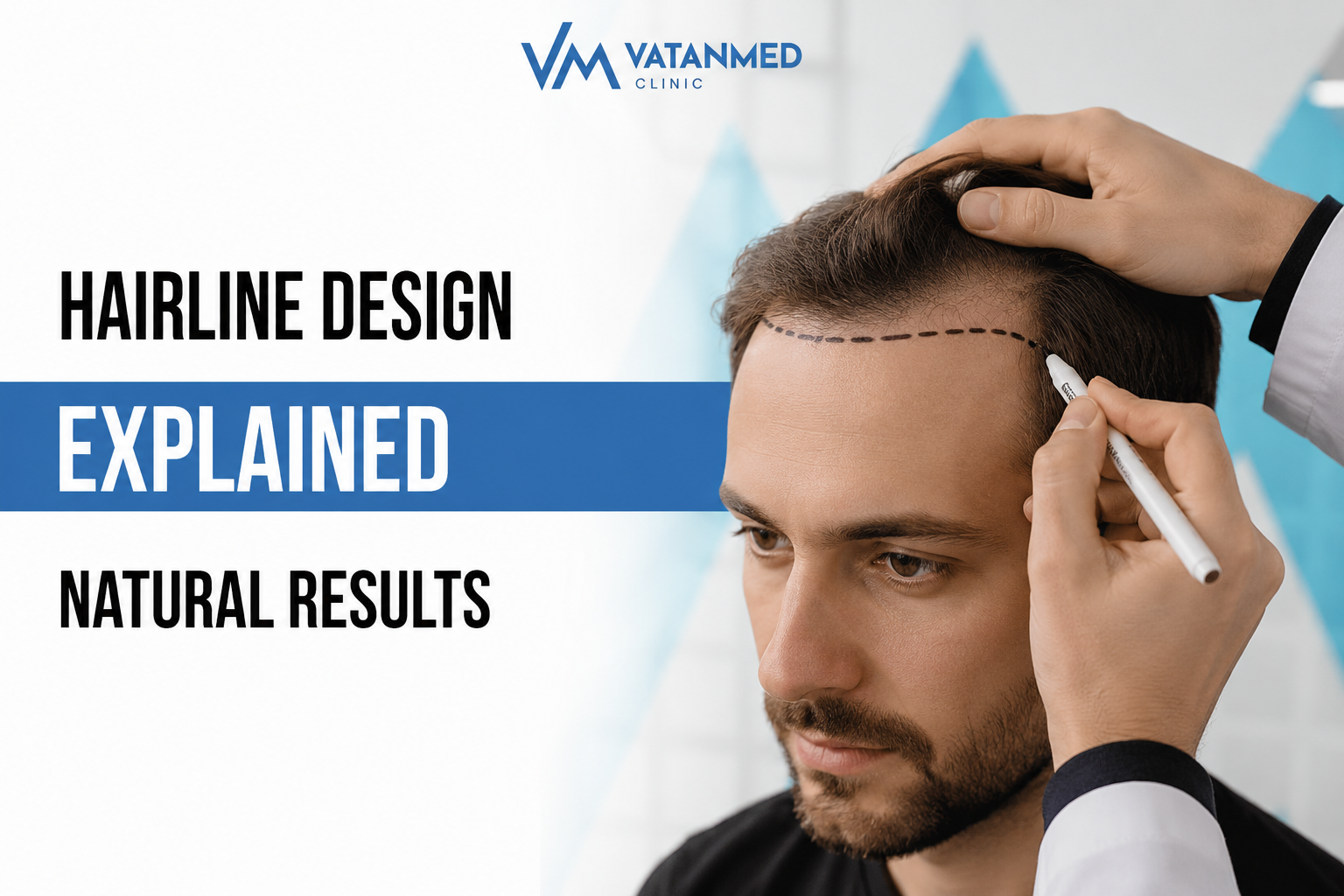
Hairline design hair transplant planning is one of the most important parts of achieving a natural-looking result. Many patients focus on graft numbers, technique names or price, but the hairline is usually the first thing people notice after a hair transplant.
A well-planned hairline can frame the face, restore balance and improve confidence. However, a poorly planned hairline can look artificial, too low, too straight or unsuitable as the patient ages. This is why hairline design hair transplant planning should never be rushed.
The best hairline is not simply the lowest hairline possible. A natural result depends on the patient’s age, face shape, forehead proportions, donor area strength, hair loss pattern, graft direction, hair thickness and long-term expectations.
At VatanMed, patients can learn more about hair transplant services before deciding whether treatment may be suitable. VatanMed provides hair transplantation services for the head, beard, moustache and eyebrow areas, with international clinic locations and its main branch in Istanbul.
This guide explains why hairline design hair transplant planning matters, how a natural hairline is created, what mistakes should be avoided, and why consultation is essential before choosing a final hairline.
Why Hairline Design Matters in Hair Transplant Surgery
Hairline design hair transplant planning matters because the hairline shapes the entire result. Even if the grafts grow well, the result may not look natural if the hairline is placed incorrectly or designed without considering the patient’s features.
A natural hairline should not look like a solid straight line. Real hairlines usually have softness, small irregularities, gradual density and carefully placed single-hair grafts at the front. The aim is to recreate a natural appearance, not to draw a perfect line across the forehead.
The NHS hair transplant guide explains that hair transplant surgery involves moving hair to areas that are thin or bald. Because transplanted hair is placed into a visible area, planning and design are essential.
Hairline design affects:
- How natural the result looks
- How well the transplant frames the face
- How dense the front appears
- How grafts are distributed
- How the result may age over time
- How much donor hair is used
- Whether future hair loss can still be managed
A responsible hairline design hair transplant plan should balance appearance, donor safety and long-term planning.
What Makes a Hairline Look Natural?
A natural-looking hairline is not perfectly straight or overly dense at the front. It usually has a soft transition from the forehead into thicker hair behind it. This front transition is important because it prevents the hairline from looking harsh or artificial.
In hairline design hair transplant planning, the clinic should consider natural irregularity, hair direction, temple shape, density and the patient’s facial proportions. Small details can make a major difference in the final appearance.
Single-hair grafts are often used at the very front of the hairline because natural hairlines usually begin with finer, softer hairs. Thicker multi-hair grafts are generally placed behind the front line to create density and support.
A natural hairline usually includes:
- Soft front transition
- Slight irregularity
- Correct graft direction
- Single-hair grafts at the front
- Balanced temple design
- Age-appropriate position
- Density that matches donor supply
- Long-term planning for future hair loss
The goal of hairline design hair transplant planning is to create a result that looks natural in real life, not only in close-up clinic photos.
Age and Face Shape in Hairline Planning
Age is an important factor in hairline design. A very low teenage-style hairline may not suit an adult patient and may look unnatural as the patient gets older. The hairline should match both the patient’s current appearance and future ageing.
Face shape also matters. A hairline should support the patient’s natural facial proportions. Some patients need temple support, while others need a softer frontal frame. The right design depends on individual assessment.
In hairline design hair transplant planning, the clinic should avoid copying the same template for every patient. A natural result requires personalisation.
Hairline position may depend on:
- Age
- Forehead height
- Face shape
- Temple recession
- Existing hair pattern
- Donor area strength
- Future hair loss risk
- Patient expectations
A good hairline design hair transplant plan should improve the patient’s appearance without creating a design that looks artificial or difficult to maintain over time.
Why a Low Hairline Is Not Always Better
Many patients want the lowest possible hairline because they believe it will create a younger appearance. However, a low hairline is not always the best choice. It may require more grafts, use too much donor hair and look unnatural as the patient ages.
Donor hair is limited. If too many grafts are used to create a low hairline, there may be fewer grafts available for future hair loss in the mid-scalp or crown. This can become a problem if the patient’s native hair continues to thin.
That is why hairline design hair transplant planning should protect donor supply. The safest hairline is often one that looks balanced and natural, rather than aggressively low.
A low hairline may create problems if:
- It does not suit the patient’s age
- It uses too many grafts
- The donor area is limited
- Future hair loss is likely
- The temples are not planned properly
- The design looks too straight or dense
- The patient expects unrealistic density
Patients can learn more about donor area planning here: Donor Area Hair Transplant: Key Checks.
Donor Area and Hairline Design
The donor area plays a major role in hairline design hair transplant planning. The donor area provides the grafts used to create the new hairline. If the donor area is strong, the clinic may have more planning flexibility. If it is limited, the hairline must be more conservative.
A responsible clinic should not design a hairline without assessing the donor area. The planned hairline must match the number of grafts that can be extracted safely. A design that looks good on paper may not be suitable if the donor area cannot support it.
Patients should be careful if a clinic promises a very low hairline or high density without explaining donor safety. Natural results require balance between the recipient area and donor area.
Donor area assessment should consider:
- Donor density
- Hair thickness
- Safe graft availability
- Previous procedures
- Scalp condition
- Risk of overharvesting
- Future treatment options
The International Society of Hair Restoration Surgery patient education page provides information for people considering hair restoration and supports informed decision-making before treatment.
Graft Direction and Hairline Angles
Graft direction is one of the most important technical details in hairline design hair transplant planning. Natural hair does not grow straight out from the scalp in the same direction everywhere. The angle changes depending on the area of the scalp.
If grafts are implanted at the wrong angle, the hairline may look unnatural even if the grafts survive and grow. Correct direction helps the transplanted hair blend with existing hair and sit naturally when styled.
The front hairline often needs very careful angle control. The goal is to place grafts in a way that follows natural growth patterns and avoids a plug-like appearance.
Graft direction affects:
- Natural hair flow
- Styling options
- Hairline softness
- How light reflects from the scalp
- Blending with native hair
- Overall realism of the result
This is why hairline design hair transplant planning is both medical and artistic. It requires technical precision and an understanding of natural hair patterns.
Density Planning at the Hairline
Density is another key part of hairline planning. Patients often want very high density, but the clinic must consider donor supply, graft survival, scalp condition and long-term safety.
The front hairline usually needs a soft, natural transition. Too much density at the very front can look artificial. Too little density may look weak. The right balance depends on the patient’s hair type and treatment goals.
In hairline design hair transplant planning, density should be created gradually. Single-hair grafts can create softness at the front, while stronger grafts behind them can improve fullness.
Density planning should consider:
- Donor hair supply
- Hair shaft thickness
- Hair colour and scalp contrast
- Recipient area size
- Existing native hair
- Future hair loss risk
- Technique used
- Realistic expectations
Patients can read more about graft planning here: How Many Grafts Hair Transplant Patients May Need.
Hairline Design for Men and Women
Men and women often have different hairline patterns, so planning should not be identical. Male hairline restoration may focus on recession, temples and frontal framing. Female hairline restoration may involve softening a high hairline, improving thinning areas or addressing traction-related hair loss in suitable cases.
Hairline design hair transplant planning for women may require especially careful diagnosis because female hair loss can have many causes. Some women may be suitable for surgery, while others may need medical assessment first.
The American Academy of Dermatology hair loss diagnosis guide explains that effective hair loss treatment begins with finding the cause of hair loss. This matters because not every type of hair loss should be treated first with surgery.
Male hairline planning may focus on:
- Frontal recession
- Temple points
- Age-appropriate hairline height
- Future crown or mid-scalp loss
Female hairline planning may focus on:
- Forehead balance
- Soft frontal framing
- Traction-related thinning in suitable cases
- Diffuse thinning assessment
The best hairline design hair transplant plan should be personalised for the patient’s sex, hair loss cause, facial proportions and donor area.
Hairline Design and Technique Choice
Techniques such as FUE, Sapphire FUE and DHI may all be used in modern hair transplantation. However, technique should be chosen after assessment, not before.
Some patients may be suitable for Sapphire FUE, while others may benefit from DHI or another approach. The technique should support the hairline design, graft direction, density planning and donor safety.
In hairline design hair transplant planning, the technique is a tool. The final result depends on how well that tool is used and whether the design is suitable for the patient.
Technique choice may depend on:
- Hairline detail needed
- Recipient area size
- Existing native hair
- Donor area strength
- Number of grafts
- Scalp condition
- Patient expectations
Patients can compare methods here: Sapphire FUE vs DHI: 7 Key Differences.
Why Consultation Is Essential Before Hairline Design
Consultation is essential because a hairline cannot be designed safely without assessing the patient’s full case. Photos may help with an initial review, but the final plan should consider donor area, scalp condition, hair loss pattern, graft needs and long-term goals.
During consultation, the patient should discuss what they want, but the clinic should also explain what is realistic and medically appropriate. A good consultation should protect the patient from a design that may look unnatural or use too many grafts.
Hairline design hair transplant consultation should include both aesthetic and medical planning. The goal is not only to create a nice shape, but also to protect the donor area and plan for the future.
During consultation, patients should ask:
- Is my desired hairline realistic?
- Does this hairline suit my age and face shape?
- How many grafts are needed?
- Will my donor area support this design?
- How will graft direction be planned?
- What happens if I lose more hair later?
- Which technique may be suitable?
- What recovery should I expect?
Patients can read more here: Hair Transplant Consultation: What Happens Before the Procedure?.
Common Hairline Design Mistakes to Avoid
Some hair transplant results look unnatural because the hairline was not planned properly. These mistakes can include placing the hairline too low, making it too straight, using thick grafts at the front or ignoring future hair loss.
A safe hairline design hair transplant plan should avoid aggressive decisions that may look good immediately but become a problem later. Long-term planning is especially important for younger patients.
Patients should avoid choosing a clinic only because it promises the lowest hairline or the highest graft number. These promises may not always protect the donor area or support a natural result.
Common mistakes include:
- Hairline placed too low
- Hairline designed too straight
- Poor temple planning
- Wrong graft direction
- Too much density at the front
- Using multi-hair grafts in the front line
- Ignoring future hair loss
- Overusing donor hair in one session
The American Society of Plastic Surgeons hair transplant recovery guide provides general recovery information. Recovery matters because even a well-designed hairline needs time to heal, shed, regrow and mature.
VatanMed’s Approach to Natural Hairline Planning
At VatanMed, hairline design hair transplant planning focuses on natural appearance, donor safety and realistic results. The aim is to create a hairline that suits the patient’s face, hair type and long-term hair loss pattern.
VatanMed provides hair transplantation services for the head, beard, moustache and eyebrow areas. Patients can learn more through the official VatanMed website.
A personalised hairline plan may include donor area assessment, graft number planning, technique selection, density planning, aftercare guidance and long-term discussion.
VatanMed’s planning approach may include:
- Hair loss assessment
- Donor area review
- Face shape and hairline planning
- Graft direction planning
- Density and transition planning
- Technique recommendation after assessment
- Recovery and aftercare guidance
- Realistic expectation setting
Patients can explore clinic locations through the VatanMed Branches page or contact the team through the Contact Us page.
Frequently Asked Questions
Why is hairline design important in a hair transplant?
Hairline design hair transplant planning is important because the hairline frames the face and strongly affects how natural the result looks.
Can I choose my own hairline?
Patients can share their preferences, but the final hairline should be planned after donor area assessment, face shape review, hair loss evaluation and realistic graft planning.
Is a lower hairline always better?
No. A lower hairline is not always better. It may use too many grafts, look unnatural with age or limit future treatment options if hair loss continues.
What makes a transplanted hairline look natural?
A natural-looking hairline usually has softness, slight irregularity, correct graft direction, suitable density and single-hair grafts at the front.
Does technique affect hairline design?
Yes, technique can support hairline design, but technique alone does not guarantee a natural result. Planning, graft direction, donor quality and aftercare all matter.
How long does a hairline transplant take to look natural?
Early healing may take days to weeks, but growth and density develop gradually over several months. Final maturity can take much longer than the first recovery stage.
Final Thoughts
Hairline design hair transplant planning is one of the most important parts of creating a natural result. The hairline should suit the patient’s age, face shape, donor area, hair type and future hair loss risk.
A successful hairline is not simply low or dense. It should be soft, balanced, age-appropriate and planned with long-term donor safety in mind.
Patients should avoid choosing a hairline based only on photos, trends or marketing promises. The safest approach is consultation, personalised design, careful donor assessment and realistic expectations.
This article is for general information and does not replace personalised medical advice. For personalised guidance, contact VatanMed or visit the Branches page to find the most suitable clinic location for you.
Contact VatanMed here: https://vatanmed.com/contact-us/.