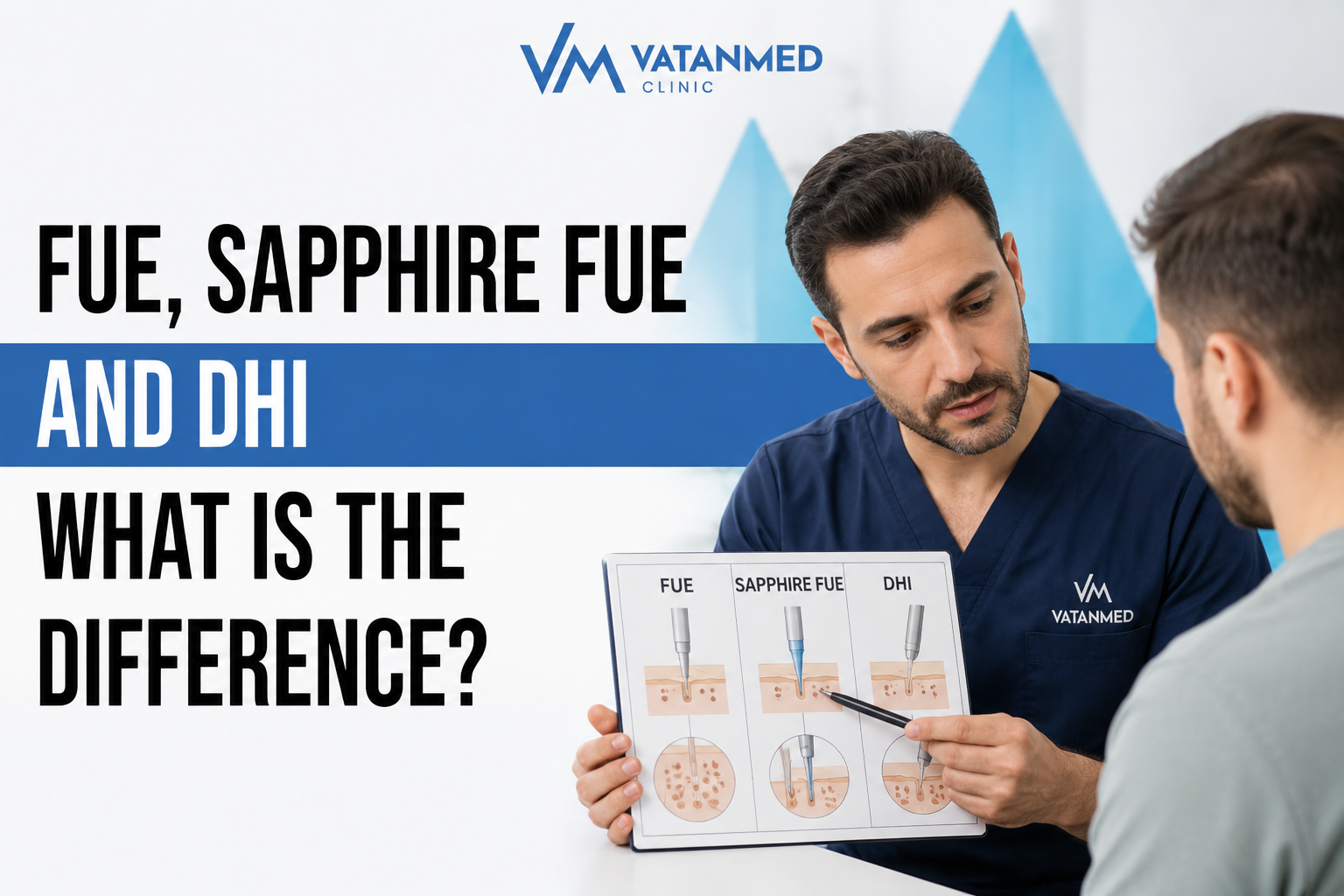
FUE Sapphire FUE and DHI hair transplant techniques are among the most common options patients see when researching hair restoration. These terms can be confusing, especially when clinics present each method as the only correct option. In reality, the most suitable technique depends on the patient’s hair loss pattern, donor area, hair thickness, scalp condition, treatment goal and medical assessment.
A hair transplant should never be planned only around a technique name. Technique matters, but it is only one part of the full treatment journey. Consultation, donor area assessment, graft handling, hairline design, implantation direction, aftercare and realistic expectations are all essential.
At VatanMed, patients can learn more about hair transplant services here: https://vatanmed.com/hair-transplant/. VatanMed provides hair transplantation services for the head, beard, moustache and eyebrow areas, with international clinic locations and a main branch in Istanbul.
This guide explains the difference between FUE, Sapphire FUE and DHI hair transplant techniques in clear patient-friendly language, while also explaining why the right choice should always be made after consultation.
What Is FUE Hair Transplant?
FUE stands for Follicular Unit Extraction. It is a modern hair transplant method where individual follicular units, commonly called grafts, are extracted from the donor area and implanted into thinning or bald areas.
The donor area is usually located at the back and sides of the scalp. These hairs are often more resistant to the pattern of genetic hair loss that affects the front, temples and crown. During FUE, grafts are removed one by one, then placed into the recipient area according to the treatment plan.
FUE became widely used because it avoids the long linear scar associated with older strip methods. However, it still requires careful extraction and planning. If too many grafts are taken from the donor area, the donor region may look thin or uneven.
The NHS explains that a hair transplant involves moving hair to an area that is thin or bald and advises patients to check the experience and qualifications of the practitioner. You can read the NHS guide here: https://www.nhs.uk/tests-and-treatments/cosmetic-procedures/cosmetic-surgery/hair-transplant/.
What Is Sapphire FUE Hair Transplant?
Sapphire FUE is a variation of the FUE technique. The extraction stage is similar in principle, but during the channel-opening stage, sapphire blades may be used instead of traditional steel blades. These sapphire blades are designed to create precise channels where the grafts will be implanted.
The aim of Sapphire FUE is to support careful channel creation, natural direction and controlled placement. However, patients should understand that the blade material alone does not guarantee a successful result. The outcome still depends on the experience of the team, graft handling, donor area planning, hairline design, aftercare and individual healing.
Sapphire FUE may be discussed for patients who need careful density planning, natural hairline work or larger coverage areas. However, suitability should always be assessed individually.
Patients can contact VatanMed to discuss whether Sapphire FUE may be suitable for their case here: https://vatanmed.com/contact-us/.
What Is DHI Hair Transplant?
DHI stands for Direct Hair Implantation. In DHI, grafts are extracted from the donor area and then implanted using a special implanter tool. The implanter allows the graft to be placed directly into the recipient area without the same separate channel-opening stage used in some other methods.
DHI may allow precise placement and can be useful in selected cases, especially where detailed work is needed. It is often discussed for hairline refinement, smaller areas, density improvement or cases where existing hair must be carefully worked around.
However, DHI is not automatically better for every patient. It may not always be the most efficient option for very large areas, depending on the case and the clinic’s planning approach. The patient’s donor area, hair loss pattern and treatment goals must be assessed first.
Sapphire FUE vs DHI: What Is the Main Difference?
The main difference between Sapphire FUE and DHI is usually in how the recipient area is prepared and how grafts are implanted.
With Sapphire FUE, channels are typically created first using sapphire blades, and grafts are then placed into those channels.
With DHI, grafts are loaded into an implanter tool and placed directly into the recipient area.
Both techniques can be used successfully in suitable patients. The best choice depends on the individual case. Patients should avoid thinking of one technique as universally better. A good clinic should explain why a method is recommended for that specific patient.
The American Academy of Dermatology explains that effective hair loss treatment starts with finding the cause of hair loss. You can read more from the AAD here: https://www.aad.org/public/diseases/hair-loss/treatment/diagnosis-treat. This is relevant because technique selection should come after diagnosis and suitability assessment, not before.
Which Technique Gives the Most Natural Result?
Natural results depend less on the name of the technique and more on the quality of planning and execution. A natural-looking hair transplant usually requires:
A realistic hairline
Correct graft direction
Careful density planning
Proper use of single-hair grafts at the front
Safe donor area extraction
Good graft handling
Appropriate technique selection
Professional aftercare
A poorly planned procedure can look unnatural even if a modern technique is used. On the other hand, a carefully planned procedure can look natural when the right technique is chosen for the patient.
For this reason, patients should focus on the full process rather than only asking, “Which technique is best?”
How Donor Area Affects Technique Choice
The donor area is one of the most important factors in choosing a hair transplant technique. If the donor area is strong, the clinic may have more flexibility. If donor hair is limited, the plan must be more conservative.
The clinic should assess:
Donor density
Hair thickness
Scalp condition
Previous procedures
Safe graft availability
Future hair loss risk
Recipient area size
A patient with a strong donor area and large treatment area may need a different plan from a patient with a small hairline correction. This is why consultation is essential.
Patients can explore VatanMed clinic locations through the Branches page here: https://vatanmed.com/branches/.
How Hairline Design Affects Technique Choice
Hairline design is another major factor. The front hairline requires very careful placement because it is the most visible part of the result. Single-hair grafts are usually placed at the front to create a softer and more natural appearance.
If a patient needs detailed hairline work, the clinic may consider which method allows the best control for that case. However, the technique must still fit the full treatment plan.
An unnatural hairline can make even a technically advanced procedure look artificial. Therefore, the hairline should be planned based on age, facial structure, donor area, hair type and long-term appearance.
Which Technique Is Better for Density?
Both Sapphire FUE and DHI may be used for density improvement, depending on the patient. However, density does not depend only on technique. It also depends on donor supply, graft survival, hair thickness, placement pattern and the size of the area being treated.
Some patients may want very high density, but the donor area may not safely support it. In these cases, the clinic should explain realistic expectations.
More grafts do not always mean a better result. A natural-looking distribution is often more important than simply using the highest number of grafts.
Which Technique Is Better for the Crown?
The crown can be more complex than the hairline because hair grows in a circular pattern. It can also require many grafts to create visible density. Some patients may need staged planning if both the front and crown are affected.
Technique choice for the crown depends on the size of the area, donor supply, existing hair, hair direction and long-term plan. The clinic may prioritise the hairline first if donor hair is limited, because the front frames the face.
The American Society of Plastic Surgeons provides information about hair transplant recovery here: https://www.plasticsurgery.org/cosmetic-procedures/hair-transplantation-and-restoration/recovery. Recovery is important because the final result develops gradually, regardless of technique.
Recovery Differences Between FUE, Sapphire FUE and DHI
Recovery can vary between patients and techniques, but many general principles are similar. Patients may experience redness, scabbing, mild swelling, donor area sensitivity and temporary shedding.
Aftercare instructions may include:
How to wash the scalp
How to sleep after the procedure
When to return to work
When to avoid exercise
How to protect the grafts
What symptoms should be reported
When follow-up may be needed
Patients should follow the clinic’s specific aftercare instructions. They should not rely only on general online advice because every case is different.
VatanMed patients can review general information on the FAQ page here: https://vatanmed.com/frequently-asked-questions/.
Is One Technique More Painful Than Another?
Pain and comfort can vary from patient to patient. Hair transplantation is usually performed with local anaesthesia, and patients may feel pressure or discomfort rather than sharp pain during certain stages. After the procedure, mild soreness, tightness or sensitivity may occur.
No responsible clinic should claim that every patient will have a completely painless experience. Comfort depends on individual sensitivity, procedure length, technique, anaesthesia response and recovery.
The important point is that the clinic should explain what to expect and how discomfort is managed.
How Should Patients Choose Between FUE, Sapphire FUE and DHI?
Patients should not choose alone based only on internet research. The best choice should be made after consultation.
A proper consultation should answer:
What is causing the hair loss?
Is the donor area strong enough?
How many grafts are suitable?
Which areas should be prioritised?
What technique is recommended and why?
What result is realistic?
What recovery should be expected?
Could future hair loss affect the plan?
The International Society of Hair Restoration Surgery provides patient education around hair restoration and safety. You can visit ISHRS here: https://ishrs.org/.
Why VatanMed Focuses on Personalised Planning
At VatanMed, technique selection is part of the wider planning process. The aim is to understand the patient’s hair loss, donor area, goals and long-term expectations before recommending an approach.
VatanMed provides services for hair, beard, moustache and eyebrow transplantation. Patients can learn more through the official website here: https://vatanmed.com/.
A personalised plan is important because the same technique will not suit every patient. Some patients may benefit from Sapphire FUE. Others may be more suitable for DHI. Some may need staged treatment or a conservative plan to protect the donor area.
Frequently Asked Questions
What is the difference between FUE and Sapphire FUE?
FUE refers to the extraction of individual grafts from the donor area. Sapphire FUE is a variation where sapphire blades may be used during channel creation in the recipient area.
What is the difference between Sapphire FUE and DHI?
In Sapphire FUE, channels are usually created first and grafts are then implanted. In DHI, grafts are placed using an implanter tool. The best choice depends on the patient’s case.
Is DHI better than Sapphire FUE?
DHI is not automatically better for every patient. It may be suitable for some cases, while Sapphire FUE may be more appropriate for others. Consultation is needed.
Which hair transplant technique gives the most natural result?
Natural results depend on hairline design, graft direction, donor area planning, density distribution and technique suitability, not only the name of the method.
Can I choose the technique myself?
Patients can discuss preferences, but the clinic should recommend the most suitable method after assessing the donor area, hair loss pattern and treatment goals.
Does technique affect recovery?
Recovery may vary slightly depending on the technique and patient, but aftercare, healing and individual biology are also very important.
Final Thoughts
FUE, Sapphire FUE and DHI are important hair transplant techniques, but no method is automatically the best for every patient. The right choice depends on the donor area, recipient area, hairline goals, hair type, medical suitability and long-term planning.
Patients should avoid choosing a technique based only on marketing. A safe and natural result depends on consultation, careful planning, experienced execution and proper aftercare.
If you want to understand whether FUE, Sapphire FUE or DHI may be suitable for you, contact VatanMed for a personalised consultation: https://vatanmed.com/contact-us/.