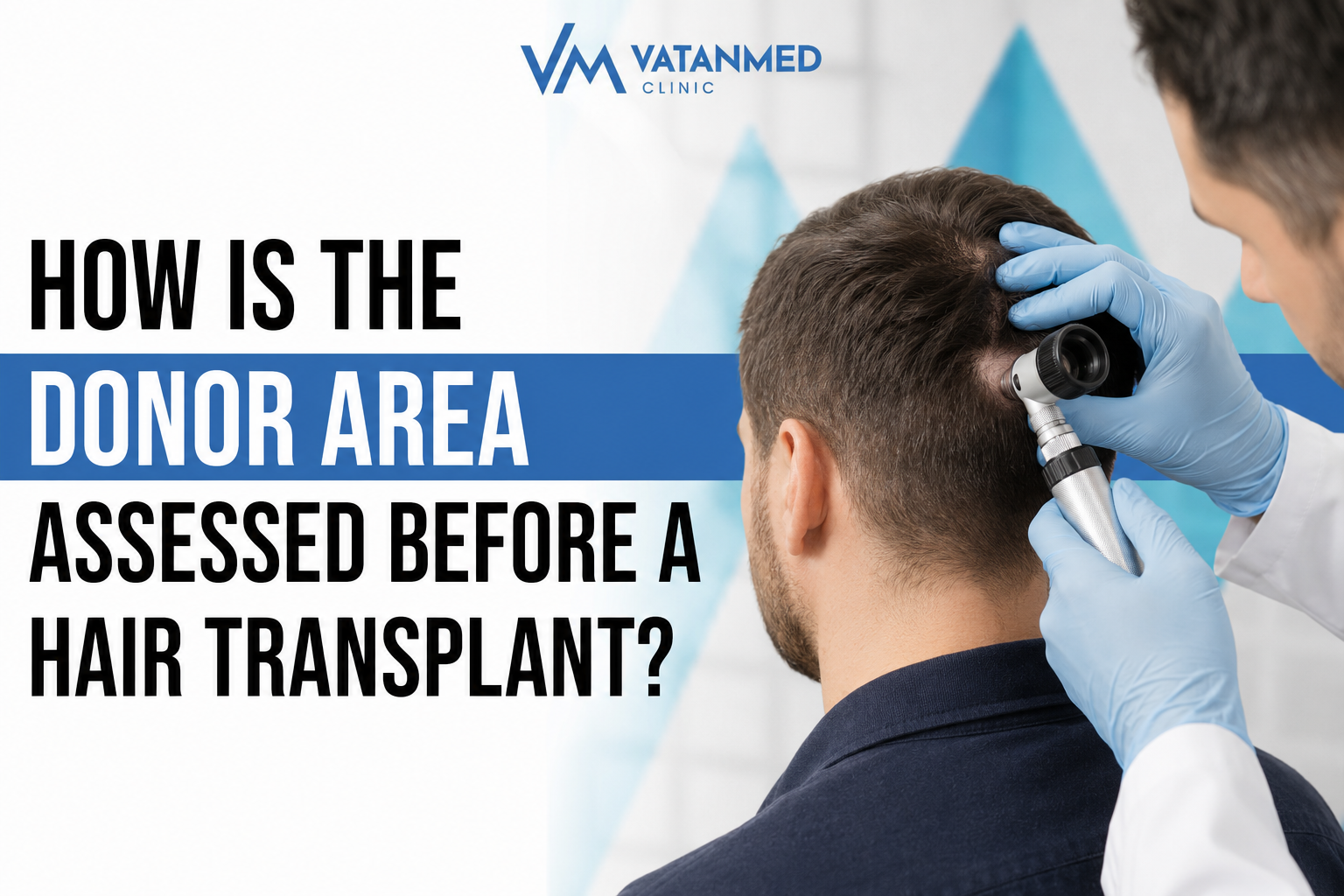
Donor area hair transplant assessment is one of the most important parts of safe and successful hair restoration planning. Many patients focus mainly on the thinning area, the new hairline, or the number of grafts they want. However, the success of a hair transplant depends heavily on the quality, strength, and availability of donor hair.
The donor area is usually located at the back and sides of the scalp. This is where hair follicles are extracted before being implanted into thinning or bald areas. If the donor area is strong, the clinic may have more flexibility when planning coverage and density. If the donor area is limited, the treatment must be planned carefully to avoid overharvesting and to protect the natural appearance of the donor region. This is why donor area hair transplant planning should always be completed before deciding how many grafts can be used safely.
At VatanMed, donor area hair transplant assessment is part of the hair transplant consultation and planning process. Patients can learn more about VatanMed hair transplant services here: https://vatanmed.com/hair-transplant/. The aim is to understand whether a patient is suitable for treatment, how many grafts may be used safely, and which technique may be appropriate.
What Is the Donor Area in a Hair Transplant?
The donor area is the part of the scalp where hair follicles are taken from during a hair transplant. In most cases, this area includes the back and sides of the head because these hairs are often more resistant to the pattern of hair loss that affects the front, temples, and crown.
During techniques such as Sapphire FUE or DHI hair transplant, individual grafts are extracted from the donor area and then placed into the recipient area. The number of grafts that can be safely extracted depends on donor density, hair thickness, scalp condition, previous procedures, and the patient’s long-term hair loss pattern.
This is why the donor area must be assessed before deciding how many grafts to use. A responsible clinic should never plan only around the patient’s desired result. It must also consider what the donor area can safely provide.
Why Is Donor Area Hair Transplant Assessment So Important?
Donor area hair transplant assessment is important because donor hair is limited and must be used responsibly. A patient does not have an unlimited supply of grafts. Once grafts are extracted, they cannot simply be replaced in the donor area. For this reason, responsible planning is essential.
A proper donor area assessment helps the clinic understand:
How many grafts may be safely available
Whether the donor area is strong enough for treatment
How much coverage may be realistic
Whether one session is enough or future planning is needed
How to avoid visible thinning in the donor area
Which technique may be more suitable
How to create a natural-looking long-term result
A careful donor area hair transplant plan helps protect both the donor region and the final appearance of the transplanted area.
Without proper donor assessment, there is a risk of overharvesting, poor density planning, unnatural results, or disappointment with the final outcome.
The NHS explains that a hair transplant is a procedure that moves hair to an area that is thin or bald and advises patients to check the experience and qualifications of the practitioner. You can read the NHS guidance here: https://www.nhs.uk/tests-and-treatments/cosmetic-procedures/cosmetic-surgery/hair-transplant/.
How Does the Clinic Check the Donor Area Before a Hair Transplant?
During a consultation, the medical team may assess several donor area factors. These help determine whether the patient is a suitable candidate and how the treatment should be planned. A donor area hair transplant assessment is not only about counting grafts. It also considers hair quality, scalp health, hair-loss progression, and how the donor area may look after extraction.
- Donor Density
Donor density refers to how many hair follicles are available in the donor area. A patient with higher donor density may have more available grafts than someone with naturally thin donor hair.
However, density is not only about numbers. The clinic must also consider how much hair can be removed safely without making the donor area look thin or patchy. Taking too many grafts can damage the balance between the donor and recipient areas.
This is one of the main reasons a donor area hair transplant plan should be personalised for every patient.
- Hair Thickness
Hair thickness can strongly influence the visual result. Thicker hair may create the appearance of better coverage, while finer hair may require more careful planning. Two patients may receive a similar number of grafts but achieve different visual density depending on hair calibre.
This is why graft numbers alone do not tell the full story. Hair quality is also important. A professional assessment looks at both quantity and quality.
A professional donor area hair transplant assessment looks at both the number of available grafts and the quality of those grafts.
- Hair Colour and Scalp Contrast
The contrast between hair colour and scalp colour can affect how dense the result appears. For example, dark hair on a light scalp may make thinning more visible, while lower contrast may create a softer appearance.
This factor can influence hairline planning, graft placement, density expectations, and how the final result may appear in different lighting.
- Scalp Condition
The donor area should be healthy before graft extraction. Scalp inflammation, infection, irritation, scarring, or certain skin conditions may affect suitability or require treatment first.
The American Academy of Dermatology explains that hair loss has many possible causes and that effective treatment starts with finding the cause. You can read more here: https://www.aad.org/public/diseases/hair-loss/treatment/diagnosis-treat.
If there are concerns about scalp health, the clinic may recommend further assessment before proceeding.
- Hair Loss Pattern
The clinic must consider whether the donor area itself is stable. Some patients may have thinning that extends into areas normally used for graft extraction. If this happens, the donor supply may be weaker than expected.
Long-term planning is especially important for younger patients or patients with progressive hair loss. The aim should be to use donor hair wisely, not only for the immediate result but also for future appearance.
What Is a Graft and Why Does It Matter?
A graft is a naturally occurring group of hair follicles. Some grafts contain one hair, while others may contain two, three, or more hairs. During a hair transplant, grafts are extracted from the donor area and implanted into the thinning or bald area.
The number of grafts needed depends on the size of the area being treated, the desired density, the hairline design, the patient’s hair type, and the strength of the donor area.
Patients often ask, “How many grafts do I need?” However, the better question is: “How many grafts can be used safely and naturally in my case?”
This is exactly why donor area hair transplant planning is so important. A high graft number may sound attractive, but the right graft number is the one that protects the donor area while creating a realistic improvement.
VatanMed patients can review general information through the FAQ page here: https://vatanmed.com/frequently-asked-questions/. For graft planning, however, an individual consultation is always needed.
Can the Donor Area Be Too Weak for a Hair Transplant?
Yes. In some cases, the donor area may not be strong enough for the result the patient wants. This can happen when donor density is low, hair is very fine, the area has been overharvested in a previous procedure, or hair loss affects the donor region.
If the donor area is weak, the clinic may recommend a more conservative plan. This may include focusing on the most visible areas, lowering the expected graft number, or discussing whether the patient is suitable for treatment.
A responsible clinic should not promise high graft numbers if the donor area cannot safely support them. More grafts do not always mean a better result. The right number of grafts depends on safe extraction, natural design, and long-term planning.
A careful donor area hair transplant assessment helps protect the patient from unrealistic expectations and supports safer treatment planning.
What Happens If Too Many Grafts Are Taken?
Taking too many grafts from the donor area can create problems. The donor area may look thin, uneven, or patchy. This is often described as overharvesting.
Possible issues from poor donor management include:
Visible thinning at the back or sides of the scalp
Uneven donor appearance
Reduced options for future procedures
Lower overall patient satisfaction
An unnatural balance between donor and recipient areas
This is why donor preservation is a key part of hair transplant planning. A natural result depends not only on the front hairline but also on how carefully the donor area is managed.
The International Society of Hair Restoration Surgery provides patient education and safety information for people considering hair restoration procedures. You can read more from ISHRS here: https://ishrs.org/patients/getting-started/.
How Does Donor Area Hair Transplant Planning Affect Hairline Design?
Hairline design should always be planned with the donor area in mind. A very low or aggressive hairline may require many grafts. If the donor area cannot support that plan, the result may not be realistic or sustainable.
A natural hairline should match the patient’s age, face shape, hair type, donor supply, and future hair loss risk. In many cases, a slightly more conservative hairline can look more natural and protect donor grafts for long-term needs.
This is especially important for younger patients whose hair loss may continue over time.
Patients considering treatment can explore VatanMed clinic locations here: https://vatanmed.com/branches/. Choosing the right clinic location can make consultation and aftercare easier, especially for international patients.
Does the Donor Area Heal After Hair Transplant?
After graft extraction, the donor area goes through a healing process. Mild redness, sensitivity, small scabs, or temporary discomfort may occur in the early recovery period. Patients should follow the clinic’s aftercare instructions carefully to support healing.
Healing can vary from person to person depending on skin type, technique, aftercare, and individual recovery. Patients should avoid scratching, picking scabs, or using products not recommended by the clinic.
If unusual pain, swelling, discharge, or signs of infection appear, patients should contact the clinic for advice.
Good aftercare is part of the full donor area hair transplant journey. The way the donor area is cleaned, protected, and monitored after treatment can support recovery and help reduce unnecessary irritation.
Can Beard Hair Be Used as a Donor Area?
In some cases, beard or body hair may be discussed as an additional donor source. However, this depends on the patient and the treatment goal. Beard hair is different from scalp hair in texture, growth cycle, thickness, and appearance.
For many patients, the scalp donor area remains the main donor source. If another donor source is considered, it should be planned carefully and explained clearly during consultation.
A donor area hair transplant plan using beard or body hair should be approached carefully because the hair may not behave or look exactly like scalp hair.
VatanMed also provides beard transplant services, and patients can learn more through the VatanMed website: https://vatanmed.com/.
Why Technique Matters: Sapphire FUE and DHI
Techniques such as Sapphire FUE and DHI are commonly used in modern hair transplantation. The most suitable technique depends on the patient’s hair loss pattern, donor area, recipient area, and treatment goals.
However, technique alone does not guarantee a result. The quality of the consultation, graft handling, extraction pattern, hairline design, implantation angle, and aftercare all matter.
For this reason, patients should focus on the full treatment process rather than choosing a clinic based only on technique names.
The British Association of Dermatologists explains that individual circumstances can affect medical advice and treatment. Their patient information on androgenetic alopecia can be found here: https://www.bad.org.uk/pils/hair-loss-male-pattern-androgenetic-alopecia.
A strong donor area hair transplant result depends on matching the right technique with the right patient. The technique should support safe extraction, natural implantation, and responsible long-term planning.
How VatanMed Plans the Donor Area
At VatanMed, the donor area is assessed as part of the full hair transplant planning process. The goal is to create a treatment plan that respects the patient’s donor supply, supports a natural-looking result, and considers long-term appearance.
The planning process may include:
Checking donor density and hair quality
Reviewing the hair loss pattern
Estimating safe graft numbers
Discussing realistic expectations
Choosing a suitable technique
Planning the recipient area carefully
Providing aftercare and follow-up guidance
The purpose of donor area hair transplant planning is not only to move grafts. It is to protect the donor area, create natural coverage, and support a result that looks balanced from all angles.
Patients who want to discuss donor area suitability can contact VatanMed here: https://vatanmed.com/contact-us/.
Questions Patients Should Ask About the Donor Area
Before treatment, patients should ask direct questions about donor area planning. This helps avoid confusion and supports realistic expectations.
Useful questions include:
- Is my donor area strong enough for a hair transplant?
- How many grafts can be extracted safely?
- Will my donor area look thinner after extraction?
- Which areas will be prioritised for coverage?
- Could I need another session in the future?
- How will the clinic avoid overharvesting?
- What aftercare is needed for the donor area?
- Which technique is most suitable for my donor area hair transplant plan?
- How will my future hair loss be considered?
Patients should feel comfortable asking these questions before making a decision.
Common Myths About the Donor Area
Myth 1: Everyone Has Unlimited Donor Hair
This is not true. Donor hair is limited and must be used carefully. Once grafts are removed, they cannot be replaced in the donor area.
Myth 2: More Grafts Always Mean Better Results
Not always. The right number of grafts depends on safe extraction, natural design, and the patient’s donor area. Too many grafts can damage the donor appearance.
Myth 3: The Donor Area Does Not Need Planning
The donor area is one of the most important parts of hair transplant planning. Poor donor management can affect both appearance and future options.
Myth 4: All Patients Can Achieve the Same Density
Results vary between patients. Hair thickness, donor density, hair loss pattern, scalp characteristics, and healing all affect the final appearance.
Myth 5: A Donor Area Hair Transplant Assessment Is Only Needed for Severe Hair Loss
This is not correct. Donor area assessment is important for every patient, whether hair loss is mild, moderate, or advanced. Even smaller procedures require careful planning to protect the donor supply.
Frequently Asked Questions
What is the donor area in a hair transplant?
The donor area is the part of the scalp where hair follicles are extracted for transplantation. It is usually located at the back and sides of the head.
Why is the donor area important?
The donor area provides the grafts used during the procedure. Its strength, density, and quality affect how many grafts can be used and what result may be realistic.
Can the donor area run out of hair?
Yes. Donor hair is limited. This is why careful planning is necessary to avoid overharvesting and preserve future options.
How many grafts can be taken from the donor area?
This depends on the individual patient. Donor density, hair thickness, scalp condition, previous procedures, and long-term planning all affect the safe graft number.
Will the donor area look normal after a hair transplant?
With careful extraction and proper planning, the donor area should be managed to maintain a natural appearance. Healing and final appearance can vary between patients.
Can I have a second hair transplant if I need one later?
Some patients may be suitable for a future session, but this depends on remaining donor hair and the previous treatment plan. Preserving the donor area is important for this reason.
Final Thoughts
The donor area is one of the foundations of a successful hair transplant. It affects graft numbers, density, hairline planning, future options, and the overall natural appearance of the result.
A good hair transplant plan should never focus only on the recipient area. It should also protect the donor area and use available grafts responsibly. This is why consultation, assessment, and realistic planning are essential before treatment.
Donor area hair transplant assessment helps patients understand what is possible, what is safe, and what type of result may be realistic. It also helps reduce the risk of overharvesting, poor density planning, or unnatural outcomes.
If you want to understand whether your donor area is suitable for a hair transplant, contact VatanMed for a personalised consultation: https://vatanmed.com/contact-us/.